


Housebreaking a Lhasa Apso is one of those things that tests your patience in ways you didn’t know existed. The breed has a well-deserved reputation for being one of the more challenging small dogs to potty train, and if you’ve been tearing your hair out, you’re in very good company. But here’s the thing: it’s absolutely achievable. It just takes a consistent approach, realistic expectations, and more paper towels than you thought one household could ever need.

For more on working with your Lhasa’s stubborn streak, have a look at our guide to training a stubborn Lhasa Apso.
The reason Lhasas are trickier than some breeds comes down to their temperament. They’re independent thinkers who don’t see the point of doing something just because you’ve asked nicely. They’re also small, which means their bladders are small, which means they need to go more frequently than larger breeds. And being low to the ground, they can sneak off to a quiet corner and do their business before you’ve even noticed they’ve left the room.
Start with a schedule
Puppies need to go outside far more often than you’d think. A good rule of thumb is that a puppy can hold their bladder for roughly one hour per month of age. So a two-month-old puppy needs to go out every two hours. A four-month-old, every four hours. This applies during the day; overnight, most puppies can hold it a bit longer because their metabolism slows during sleep.
Take your Lhasa outside immediately after waking up, after every meal, after play sessions, and after naps. These are the highest-risk times for accidents. Go to the same spot each time so your puppy builds an association between that location and the act of going to the toilet. Stand quietly and wait. Don’t play, don’t chat, just let them focus on the job at hand.
When they go, praise them enthusiastically and give a small treat immediately. Timing matters here. The reward needs to happen within seconds of them finishing so they connect the act with the reward. If you wait until you’re back inside, you’re rewarding them for walking through the door, not for going to the toilet.
Crate training: your best friend
A crate is not a prison. Used properly, it’s a den that your Lhasa feels safe and comfortable in, and it’s the single most effective tool for housebreaking. Dogs instinctively avoid soiling their sleeping area, so a correctly sized crate encourages them to hold it until you take them outside.
The crate should be big enough for your Lhasa to stand up, turn around, and lie down comfortably, but not so big that they can use one end as a toilet and the other as a bed. If you’ve bought a crate for their adult size, use a divider to reduce the space while they’re small.
Introduce the crate gradually. Feed meals inside it. Leave the door open initially and let your puppy explore it on their own terms. Once they’re comfortable going in and out, start closing the door for short periods while you’re in the room. Build up duration slowly. If your puppy whines, wait for a quiet moment before opening the door so you don’t teach them that crying gets results.
Handling accidents
Accidents will happen. That’s a guarantee, not a possibility. How you handle them matters enormously. If you catch your puppy mid-squat, clap your hands to interrupt them and immediately take them outside to finish. If they complete the job outside, reward as normal. If you find an accident after the fact, clean it up silently and move on. Punishing a dog after the event does nothing except make them afraid of you. They genuinely cannot connect a puddle on the floor with something they did ten minutes ago.
Rubbing their nose in it, shouting, or showing them the mess is completely counterproductive. All it teaches them is that they need to hide better next time, which is how you end up with a dog that goes behind the sofa instead of in front of you. Clean up with an enzymatic cleaner that breaks down the urine compounds completely. Standard cleaning products mask the smell for human noses but leave traces that your dog can still detect, which draws them back to the same spot.
The Lhasa stubborn streak
Here’s where breed-specific advice matters. Lhasas are smart enough to learn housebreaking quickly but independent enough to decide it doesn’t apply when the weather is bad, the grass is wet, or they simply aren’t in the mood. You might find your perfectly trained Lhasa suddenly refusing to go outside when it’s raining, then promptly weeing on the kitchen floor. This is not a training failure. This is a Lhasa being a Lhasa.
The solution is to be more stubborn than they are. If your Lhasa refuses to go outside because it’s raining, stand out there with them (under an umbrella, because you’re not daft) and wait. If they don’t go within five minutes, bring them back in but crate them or supervise closely, then try again in 15 minutes. Repeat until they go. Then praise and reward like they’ve just won Crufts.
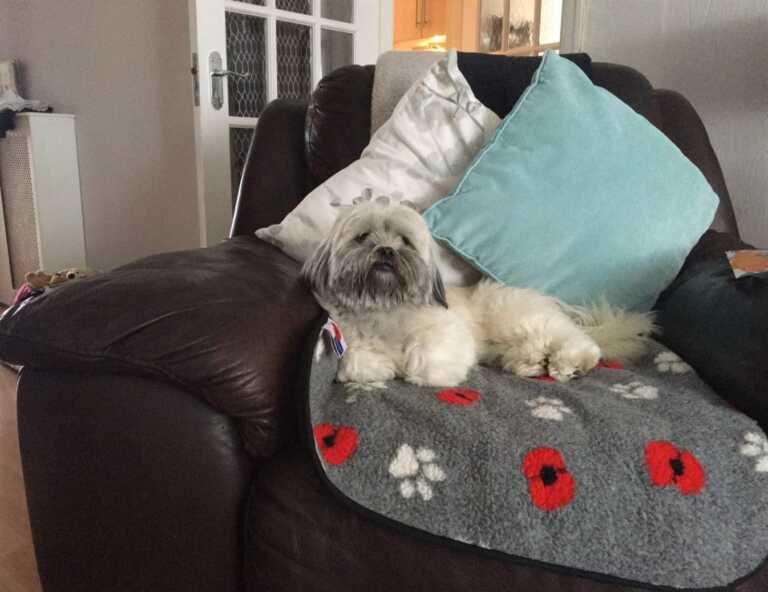
Poppy still does the “it’s raining, I refuse” routine on occasion, and she’s had years of training. Some things are just hardwired into the Lhasa personality. You learn to work around it rather than eliminate it entirely.
Puppy pads: use or avoid?
This is debated among trainers, and both sides have valid points. Puppy pads can be useful in specific situations: if you live in a high-rise flat without quick garden access, during extreme weather, or for very young puppies who can’t hold it between outdoor trips. They provide a designated indoor spot that’s easier to clean up than random carpet patches.
The downside is that pads teach your puppy that going indoors is acceptable, which can slow the transition to outdoor-only toileting. If you use pads, have a clear plan to phase them out by gradually moving the pad closer to the door, then just outside the door, then removing it entirely. Don’t use pads indefinitely as a convenience if your ultimate goal is outdoor training. It sends mixed messages.
How long does it take?
With consistent effort, most Lhasa Apso puppies are reliably housebroken between four and six months of age. Some take longer. If you’ve adopted an adult Lhasa who was never properly trained, expect the process to take at least as long as it would with a puppy, sometimes longer because you’re overwriting existing habits.
Don’t compare your Lhasa’s progress to your friend’s Labrador puppy that was trained in a week. Large breeds have larger bladders and a generally more biddable nature. Small breeds, and Lhasas in particular, operate on their own timeline. Consistency and patience are your only tools. Frustration is understandable but counterproductive.
Regression: when a trained dog starts having accidents
If your previously trained Lhasa starts having accidents again, don’t panic but do investigate. Common causes include urinary tract infections, digestive upset, stress from changes in routine or environment, and in older dogs, cognitive decline or incontinence.
Rule out medical causes first with a vet visit. If the issue is behavioural, go back to basics: increase the frequency of outdoor trips, supervise more closely indoors, and reinforce the outdoor toilet habit with rewards. Regression is frustrating but usually temporary once the underlying cause is addressed.
Survived housebreaking a Lhasa? Got a tip that saved your sanity? Share it in the comments so other owners can benefit!
Important information
Information provided by LhasaLife should not be taken as professional veterinary advice or clinical advice. It is important to consult a licensed veterinarian for any health concerns or issues with your pet. The content of the article How to housebreak a Lhasa Apso: the complete potty training guide should not be used as a substitute for veterinary care, or treatment advice for you or your pet, and any reliance on this information is solely at your own risk.
This article may contain affiliate links, meaning we may earn a small commission at no extra cost to you if you purchase through these links. Affiliate links do not necessarily imply an endorsement of the product by LhasaLife. However, we only share products we believe could be helpful to you and your beloved Lhasa Apso. Your support helps us keep the website running and full of useful content.




Comments