

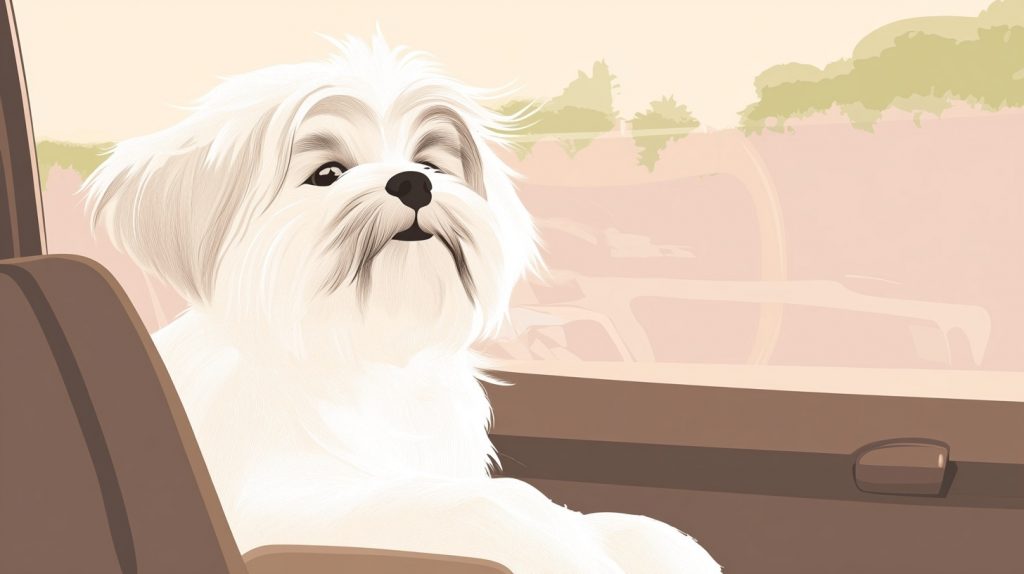
Lhasa Apsos are surprisingly good travellers. They are small enough to fit into most transport without a fuss, confident enough to handle new environments, and independent enough not to have a meltdown every time something changes. That said, travelling with any dog requires a bit of planning, and there are some breed-specific things worth knowing before you set off.
Car travel with your Lhasa Apso
Most Lhasa owners will do the majority of their travelling by car, so let us start there.
Crate or car seat?
By law, dogs must be suitably restrained in a car. For a Lhasa Apso, the two best options are a travel crate secured in the boot or back seat, or a raised car seat that clips to the seatbelt. Both keep your dog safe in the event of sudden braking.

We use a raised car seat for Poppy. She likes being able to see out of the window, and the raised position means she can survey her domain (the passing motorway scenery) with appropriate authority. A small to medium travel crate works just as well if your Lhasa prefers enclosed spaces.
Browse small dog car seats on Amazon
Dealing with car sickness
Some Lhasa Apsos get car sick, especially puppies. If your dog drools excessively, whines, or vomits during car journeys, there are a few things that help. Keep the car cool with good airflow. Avoid feeding for two hours before travelling. Start with short journeys and build up gradually. And if it is really bad, your vet can prescribe anti-nausea medication for longer trips.
Stopping regularly
For journeys over an hour, stop every couple of hours for a toilet break, a stretch, and some water. Lhasa Apsos are not high-energy dogs, but they still need to move around and have a sniff. A quick ten-minute stop at a service station (on the lead, obviously) does wonders for their comfort.
Never leave your dog in the car unattended, even with the windows cracked. Cars heat up terrifyingly fast, and small dogs like Lhasas are particularly vulnerable to heatstroke.
Train travel with a Lhasa Apso
The great thing about Lhasa Apsos is their size. They are small enough to travel on most UK trains without any issues. Most train operators allow dogs on board for free as long as they are on a lead and under control. Some operators ask that small dogs sit on your lap or in a carrier rather than on the seat.
A soft carrier or travel bag is useful for train journeys, particularly if your Lhasa is not great with crowds or noise. It gives them a safe, enclosed space and makes navigating busy stations much easier. Browse small dog travel carriers on Amazon
Poppy has been on trains a handful of times. She handles it well as long as she can see what is going on. Put her in a bag where she cannot look out and she will let you know about it. Loudly.
Dog-friendly holidays in the UK
The UK has a brilliant selection of dog-friendly accommodation, from cottages to hotels to glamping pods. Most holiday rental sites let you filter for dog-friendly properties, and more pubs, restaurants, and attractions are welcoming dogs than ever before.
When booking, check whether there is a dog supplement (usually between ten and thirty pounds per stay), whether the property has a secure garden (ideal for Lhasas who need their morning toilet without a full walk), and whether there are restrictions on where in the property dogs can go.
Lhasa Apsos are well-suited to holiday travel because they adapt quickly to new environments. They are not the type of dog that paces all night in an unfamiliar room. Give them their own bed, their usual food, and a familiar blanket, and they will settle in as if they own the place. Which, in their mind, they do.
What to pack for your Lhasa
Here is a quick packing list that covers the basics for any trip with your Lhasa Apso: their usual food (enough for the trip plus a spare day), a collapsible water bowl, poo bags, their lead and harness, a favourite toy or blanket for comfort, their grooming brush (because that coat does not take a holiday), any medication they are on, and their vaccination record or pet passport if travelling abroad.
A foldable travel crate is also worth considering. It gives your Lhasa a familiar sleeping space wherever you go and keeps them safe in holiday accommodation where they might be tempted to explore when you are not looking.
Keeping your Lhasa calm during travel
Some Lhasa Apsos take to travel like naturals. Others need a bit of help settling down. If your dog gets anxious during journeys, there are a few things that genuinely work.
A familiar blanket or toy from home can make a big difference. Dogs are comforted by scent, and having something that smells like their normal environment helps reduce stress in unfamiliar settings. We always bring Poppy’s favourite blanket on trips, and she buries herself in it the moment we arrive anywhere new.
Calming sprays containing dog-appeasing pheromones (like Adaptil) can help nervous travellers. You can spray them on the car seat cover or travel crate about 15 minutes before the journey. They are not a magic fix, but combined with other strategies, they take the edge off for many dogs.
For dogs with serious travel anxiety, your vet might suggest a mild sedative for longer journeys. This is a last resort rather than a first option, but it is worth discussing if your Lhasa is genuinely distressed by travel rather than just mildly uncomfortable.
The best long-term strategy is gradual desensitisation. Start with sitting in the parked car with the engine off. Then engine on. Then short trips around the block. Then slightly longer outings to somewhere fun, like a new walking spot. Over time, your Lhasa learns that getting in the car leads to good things, and the anxiety decreases naturally.
Flying with a Lhasa Apso
If you are considering flying with your Lhasa, the rules vary significantly by airline and destination. Within Europe, most airlines allow small dogs in the cabin in an approved carrier that fits under the seat. From the UK, the main challenge is the UK’s strict pet travel rules, which require a microchip, rabies vaccination, and an Animal Health Certificate from your vet.
Flying is stressful for dogs, so only do it if you genuinely need to. For most UK holidays, driving or taking the train with your Lhasa is far less hassle for everyone involved.
Where is the best place you have taken your Lhasa on holiday? We are always looking for dog-friendly recommendations. Share yours in the comments below.
Important information
Information provided by LhasaLife should not be taken as professional veterinary advice or clinical advice. It is important to consult a licensed veterinarian for any health concerns or issues with your pet. The content of the article Travelling with your Lhasa Apso: car, train and holiday tips should not be used as a substitute for veterinary care, or treatment advice for you or your pet, and any reliance on this information is solely at your own risk.
This article may contain affiliate links, meaning we may earn a small commission at no extra cost to you if you purchase through these links. Affiliate links do not necessarily imply an endorsement of the product by LhasaLife. However, we only share products we believe could be helpful to you and your beloved Lhasa Apso. Your support helps us keep the website running and full of useful content.


Comments