

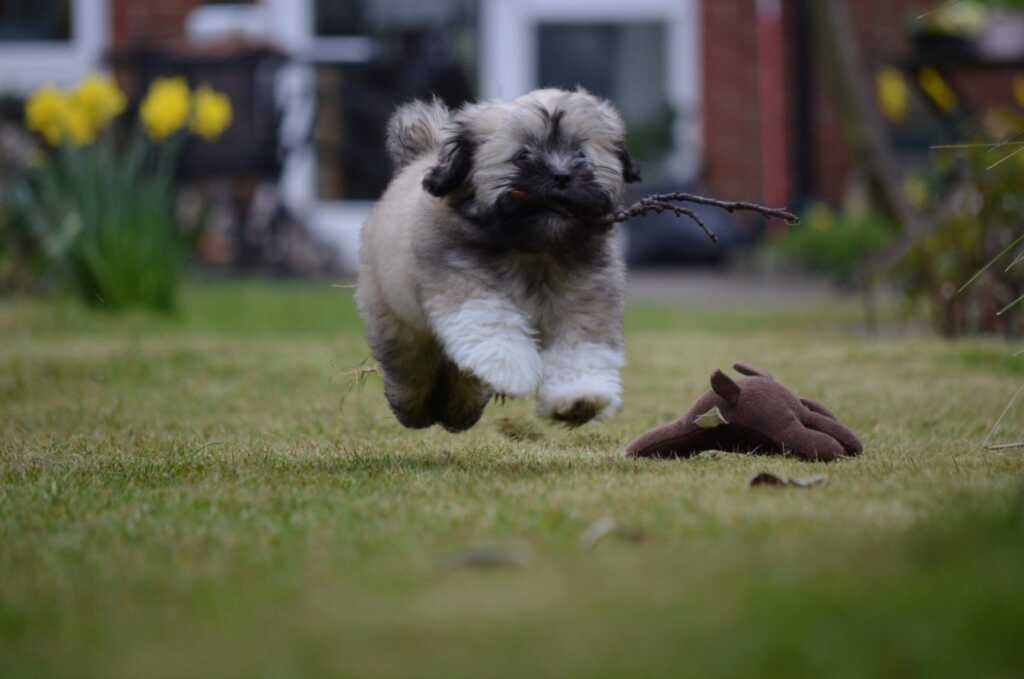
We’ve spent considerable time wondering if we accidentally adopted a small, hairy toddler instead of a dog. Poppy certainly behaves like one. She has tantrums that would make a two-year-old jealous. She demonstrates selective hearing that’s positively Olympic in its sophistication. She possesses the determination to do exactly what she wants, when she wants, regardless of what any reasonable adult might suggest.
The parallels between Lhasas and toddlers are genuinely uncanny. And we’re not being poetic here. Once you see it, you can’t unsee it. Every bit of Lhasa behaviour suddenly makes perfect sense if you accept one simple fact: you’re living with a small, furry toddler who never quite grows up.
The Stubbornness Factor
Toddlers are famously stubborn. They have an idea in their head about how something should go, and they will defend that position with the intensity of a constitutional lawyer. They won’t change their mind. They won’t be reasoned with. They will simply do what they want and dare you to stop them.

Meet your Lhasa Apso.
Lhasa temperament is fundamentally independent. That’s not something we’ve imposed on them. That’s literally in the breed standard. These were dogs who had to make their own decisions in Tibetan monasteries. They were bred to think for themselves. And they absolutely, positively will.
You can ask your Lhasa to do something. You can ask politely. You can ask with treats. You can ask with the voice reserved for one’s dearest loved ones. But at the end of the day, your Lhasa will consider your request and make an independent decision about whether to comply. If they’ve decided they’re not coming when called, they are simply not coming. The conversation is over.
This is maddening and hilarious in equal measure. It’s also absolutely peak toddler behaviour. “You said sit, but I’ve decided jumping is more interesting right now. I will jump instead.”
Selective Hearing: A Superpower
Toddlers possess the remarkable ability to hear you clearly when you’re across the house and they want something, but become mysteriously deaf when you ask them to do something less entertaining. They will absolutely hear the rustle of a crisp packet from another room. But ask them to come for a bath? Suddenly they’ve lost all auditory capacity.
Lhasas have perfected this exact skill. They have genuinely bionic hearing. Poppy can detect the sound of a cheese wrapper from three rooms away. She hears the neighbour’s dog barking two streets over. But when we’re trying to get her to come inside from the garden? Completely deaf. Profoundly deaf. Deaf to the point of requiring medical investigation.
The difference is that a Lhasa doesn’t accidentally fail to hear. They hear perfectly well. They’re simply making a calculated decision not to respond because responding would interrupt something far more interesting. They’re evaluating: does coming inside sound more pleasant than investigating that smell? It does not. Therefore, they will remain investigating the smell.
The Tantrum Spectacular
When toddlers don’t get what they want, they have tantrums. These are legendary. Throwing themselves on the ground, sobbing, absolute drama. The goal is to punish you for having the audacity to suggest something they don’t like.
Lhasas absolutely do this. If Poppy is denied something she’s decided she wants, she will protest. Loudly. Dramatically. With the body language of someone facing terrible injustice. She will do that weird Lhasa crouch thing where they flatten themselves against the floor as if gravity has suddenly become too much. She will sigh with the weight of the world.
A toddler wants you to know you’ve made a terrible mistake. A Lhasa wants you to know you’ve made a terrible mistake while simultaneously questioning your entire character. There’s more withering judgment involved with a Lhasa, is what we’re saying.
These tantrums pass just as quickly as they begin, incidentally. Both toddlers and Lhasas have the memory span of particularly forgetful goldfish. By two minutes later, the drama is entirely forgotten and your Lhasa is ready for a cuddle as if nothing whatsoever just happened.
Demanding Attention on Their Terms
Here’s where toddlers and Lhasas become nearly indistinguishable: they both demand attention, but only when they feel like it. When you’re busy? They have no interest in you. The moment you try to do something they deem less interesting than their presence, suddenly you’re being ignored with the cold fury of a spurned lover.
But when they decide they want you, they want you immediately. Right now. Not in a minute. Not after you’ve finished your email. Now. If you don’t comply, they will escalate. Jumping on your lap. Poking you with their nose. Lying across your keyboard. The subtext is entirely clear: I have decided I deserve your complete and undivided attention, and I expect you to adjust your entire day accordingly.
Getting Into Things They Shouldn’t
Toddlers are chaos agents. They find the one thing in your house you’d specifically asked them not to touch, and that becomes their singular focus. Not because they don’t understand. They understand perfectly. They simply don’t care about your rules.
Lhasas are exactly the same. They will find the one item on your coffee table that is actually poisonous to dogs, and that will be the item they’re most interested in. They will knock over your tea cup with the precision of a miniature demolition expert. They will dig under your sofa and extract every crisp you’ve ever dropped down there in the past three years.
The Lhasa puppy biting phase is peak toddler behaviour, incidentally. They’re exploring their boundaries through their mouth, which, while completely normal, feels like living in some sort of tiny, fluffy aggressive scenario.
The “I’ll Do It When I’m Ready” Attitude
Toddlers have absolutely no interest in your timeline. They will take thirty minutes to put on their shoes. They will do everything in slow motion while you’re running late. They’re not deliberately trying to frustrate you. They’re simply operating on their own internal clock.
Your Lhasa will take an infinite amount of time to come inside from the garden. They will stop in the middle of their walk to investigate something microscopic for ten minutes. They will drink their water with glacial slowness if you’re waiting for them to finish before you go out. They are operating entirely on their own schedule, and no amount of your rushing will accelerate their personal timeline.
Training a Lhasa requires accepting this aspect of their character. You cannot rush them. They will do things when they’re good and ready.
Why This Makes Them Absolutely Loveable
Here’s the remarkable bit: the exact same qualities that make toddlers occasionally infuriating are the qualities that make them utterly adorable. Their stubbornness is actually determination. Their selective hearing is selective focus. Their tantrums are passion. Their demand for attention is their way of saying you matter to them.
Lhasas are the same. The quirky charm of Lhasa Apsos is absolutely real, and it’s built entirely on these toddler-like qualities. Their independence is actually confidence. Their stubbornness is integrity. Their refusal to come when called is a way of telling you they’re still in charge of themselves, which is rather noble if you think about it.
Yes, they’re occasionally infuriating. Yes, they will test your patience. Yes, you will find yourself in situations where you genuinely cannot make your Lhasa do something they’ve decided not to do. But that’s also why they’re so entertaining, so clever, so fundamentally themselves in a way many dogs aren’t.
You’re not living with a dog. You’re living with a small, hairy philosophy student who’s decided to spend their time with you and will absolutely judge you for getting things wrong. And really, could you ask for anything better?
The barking can be excessive, admittedly. But the mischievous toddler energy is entirely part of the package. And if you’re the right human for a Lhasa, that energy is absolutely what you’ll love most about them.
Important information
Information provided by LhasaLife should not be taken as professional veterinary advice or clinical advice. It is important to consult a licensed veterinarian for any health concerns or issues with your pet. The content of the article Does your Lhasa Apso behave like a mischievous toddler? should not be used as a substitute for veterinary care, or treatment advice for you or your pet, and any reliance on this information is solely at your own risk.
This article may contain affiliate links, meaning we may earn a small commission at no extra cost to you if you purchase through these links. Affiliate links do not necessarily imply an endorsement of the product by LhasaLife. However, we only share products we believe could be helpful to you and your beloved Lhasa Apso. Your support helps us keep the website running and full of useful content.




Comments